
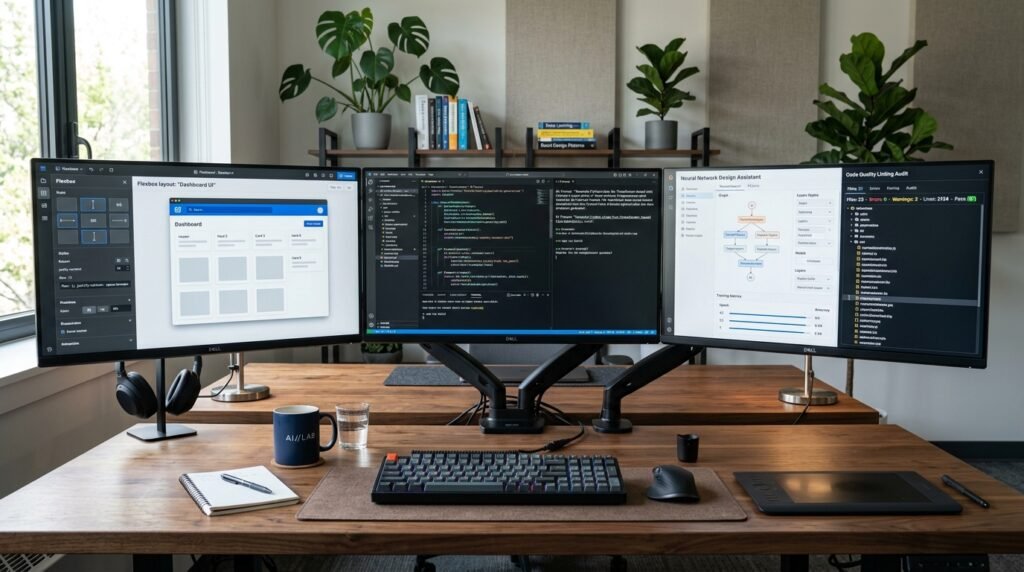
Integrating AI in website design and development has rapidly evolved from speculative experimentation into an essential engineering accelerator. In fact, modern generative algorithms assist development teams in drafting wireframes, generating boilerplates, and streamlining QA testing. However, relying on automated tools without human architectural oversight introduces severe performance and security liabilities. Therefore, understanding where artificial intelligence excels and where human engineering remains indispensable is crucial.
Accelerating Wireframing, Prototyping, and Design Iterations
The primary advantage of generative tools lies in compressing the ideation cycle. By processing structured prompts, AI platforms can instantly produce functional layout variants, color harmonies, and responsive component schemes.
Furthermore, designers can explore multiple UI archetypes before committing to high-fidelity Figma drafts. This rapid prototyping enables stakeholders to visualize interactive hierarchies early in the planning process.
Nevertheless, generic AI design generators frequently rely on repetitive visual clichés-such as uniform drop shadows and washed-out gradient blobs. Professional UI/UX specialists must refine these drafts to align with regional brand dignity and cultural expectations.
Semantic Code Generation and Assisted Engineering
Beyond visual layout, large language models significantly accelerate software engineering workflows. Developers routinely employ AI assistants to generate boilerplate HTML5 markup, modern CSS Grid declarations, and routine JavaScript utilities.
In addition, AI tools excel at writing automated unit tests, identifying syntax anomalies, and converting legacy code into modern modular standards. Consequently, engineering teams can focus their mental energy on complex business logic and database architecture.
However, AI-generated code must undergo rigorous manual review. Automated tools frequently produce bloated DOM structures, redundant dependencies, or insecure input handlers that violate Core Web Vitals and OWASP benchmarks.
Preserving Technical Governance and Human Craftsmanship
While artificial intelligence enhances productivity, it cannot replace genuine domain expertise. Crucial engineering responsibilities-such as WCAG 2.2 AA accessibility, multilingual RTL typography, and local payment gateway compliance-require experienced human engineers.
Moreover, search engines increasingly prioritize authentic, first-party technical authority over mass-generated synthetic content. Organizations that blend AI efficiency with disciplined human engineering achieve superior long-term results.
Explore our specialized corporate website design and development services to build high-performance digital platforms. Furthermore, discover our bespoke enterprise digital packages and engineering tiers.
Ultimately, artificial intelligence is a powerful collaborator rather than an autonomous replacement. By utilizing AI in website design thoughtfully, modern enterprises can build faster, cleaner, and more impactful digital experiences.
Ready to engineer a high-performance website for your enterprise?
Our engineering team in Al Khobar develops fast, natively bilingual websites and web applications tailored for Saudi business buyers and corporate bids.