
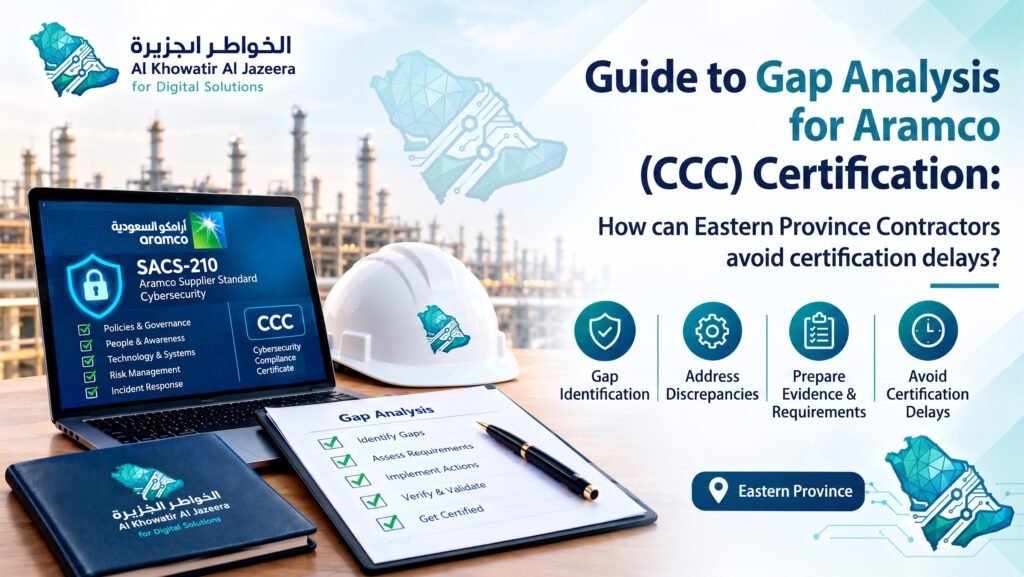
In the Eastern Province-specifically across Jubail, Dammam, and Khobar-securing the Aramco Cybersecurity Compliance Certificate (CCC) is an absolute operational requirement. Consequently, valid certification is mandatory to bid on contracts and participate in major energy projects.
Under the revised SACS-210 standard, audit requirements have become substantially more stringent. Therefore, attempting an audit without rigorous gap analysis frequently leads to costly delays. In addition, failed assessments can disrupt ongoing operations for months.
1. What Is an Aramco SACS-210 Gap Analysis?
A gap analysis is an exhaustive diagnostic review comparing your existing security controls against Aramco’s framework. As a result, this evaluation uncovers technical vulnerabilities before external auditors arrive. Furthermore, early detection provides ample time to rectify deficiencies calmly and systematically.
2. Why Contractors Fail Initial Audits
Field experience shows that audit delays stem from predictable technical oversights. For example, missing documented evidence and unverified system logs represent the most frequent audit findings.
Moreover, inadequate access controls and weak encryption policies trigger immediate non-compliance notices. In contrast, accredited third-party evaluators require concrete proof of daily technical enforcement.
3. Practical Methodology for Compliance
Achieving SACS-210 certification requires a disciplined four-stage implementation strategy:
- Step 1 (Scoping): Accurately inventory every workstation, server, and network device connecting to Aramco data. Specifically, incorrect scoping causes the majority of assessment delays.
- Step 2 (Control Assessment): Review firewall configurations, endpoint protection, and encryption protocols. In addition, ensure your organization utilizes secure official domain email architecture.
- Step 3 (Evidence Collection): Gather genuine audit logs and automated vulnerability scan reports. Consequently, the credibility of your documentation determines your assessment score.
- Step 4 (Remediation Plan): Formulate an actionable roadmap to address identified gaps before scheduled third-party auditing.
4. Strengthening Commercial E-E-A-T and Market Trust
In B2B industrial contracting, cybersecurity compliance functions as a powerful trust accelerator. Therefore, certified contractors enjoy distinct competitive advantages during major vendor selections.
Ultimately, verified compliance demonstrates proven operational resilience. As a result, your organization establishes itself as a preferred supplier for top-tier energy operators.
Preparing your company for Aramco CCC compliance or vendor prequalification?
Our technical team in Al Khobar helps Eastern Province contractors perform pre-audit gap analyses, remediate security controls under SACS-210, and prepare digital documentation to avoid onboarding delays.